
How to Become a School Security Guard in Florida
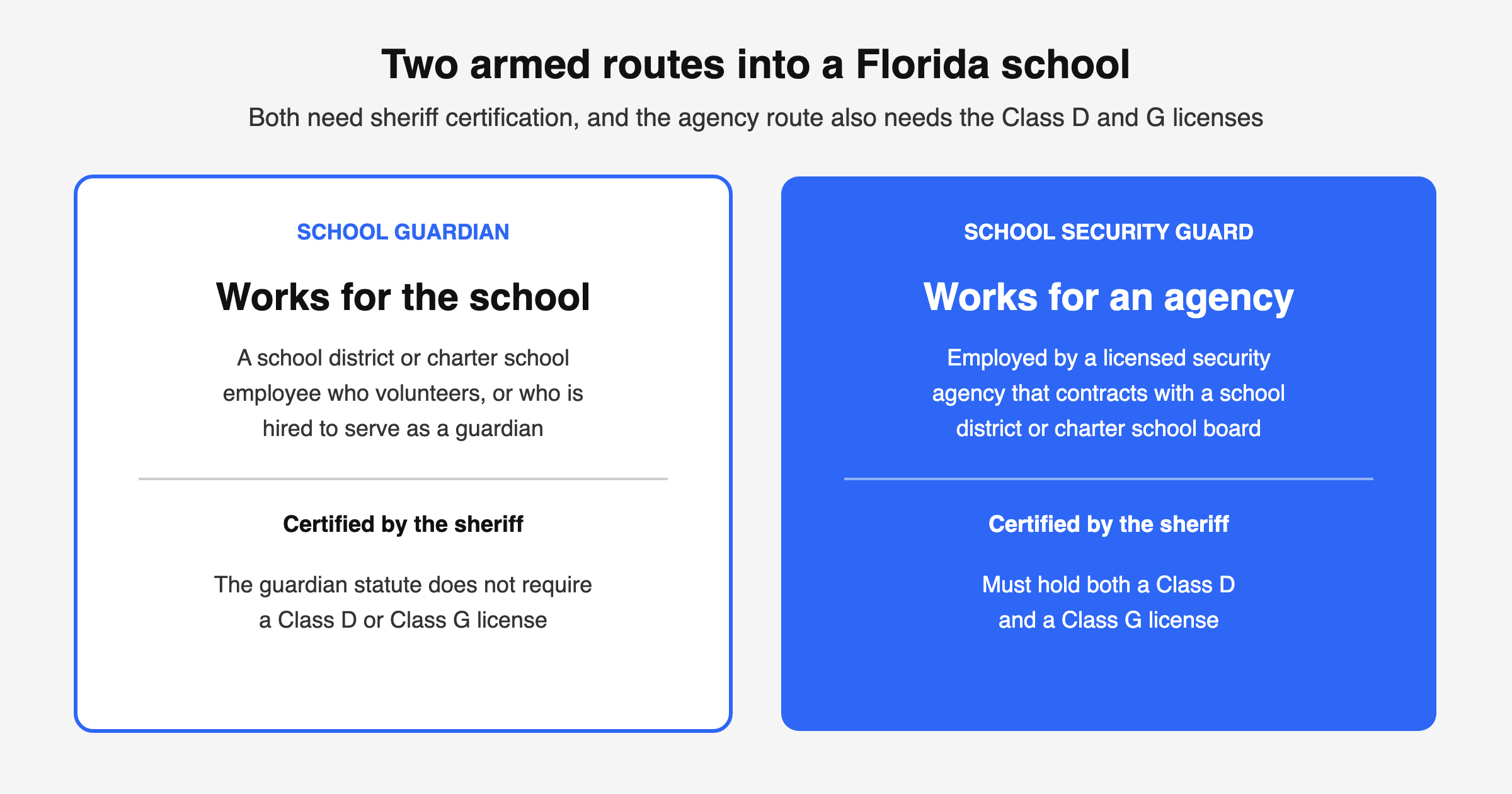
If you want to become a school security guard in Florida, know first that state law treats the school guardian as a separate role. A school guardian is a school district or charter school employee certified by the sheriff. A school security guard works for a licensed security agency, holds a Class D and a Class G license, and is also certified by the sheriff.
School guardian or school security guard
Section 1006.12 of the Florida Statutes requires every school district to establish or assign at least one safe-school officer at each school, including charter schools. The officer may be a school resource officer, a school safety officer (both certified law enforcement officers), a school guardian or a school security guard.
A school guardian is a district or charter school employee who either volunteers in addition to their regular duties or is hired specifically to serve as a guardian. The statute's requirements for guardians do not include a Class D or Class G license. Pasco County Schools' job description for its "School Safety Guard", for example, asks for concealed carry training, a Florida School Guardian certificate and CPR, and lists no security license.
A school security guard is employed by a security agency that contracts with a school district or charter school governing board, and must hold both a Class D and a Class G license. Private schools may also use safe-school officers, and must then follow the same statute. Both roles exist to help prevent or stop active assailant incidents on school premises.
Licenses you need to become a school security guard in Florida
Class D. Anyone who works as a security officer in Florida needs a Class D license. FDACS requires applicants to be at least 18 and to complete at least 40 hours of training at a licensed school, in person or live online. A Class D licensee must own or work for a Class B security agency.
Class G. A security officer who carries a firearm must also hold a Class G license, which requires 28 hours of classroom and range training taught by a Class K instructor. FDACS requires Class G applicants to be U.S. citizens or permanent legal resident aliens. The Class G remains in effect only while you are employed as a Class D (or other listed) licensee.
Concealed carry eligibility. For sheriff certification, a school security guard must hold a concealed weapon license under s. 790.06 or otherwise be eligible to carry concealed under chapter 790. Section 790.06 sets 21 as the minimum age for a concealed weapon license, while the Class D and Class G licenses start at 18.
FDACS lists new license fees of $97.75 for the Class D and $164.75 for the Class G ($179.75 with a temporary Class G license).
The sheriff's 144-hour program and screening
The licenses alone do not qualify you to work in a school. Under s. 1006.12(4), a school security guard must also:
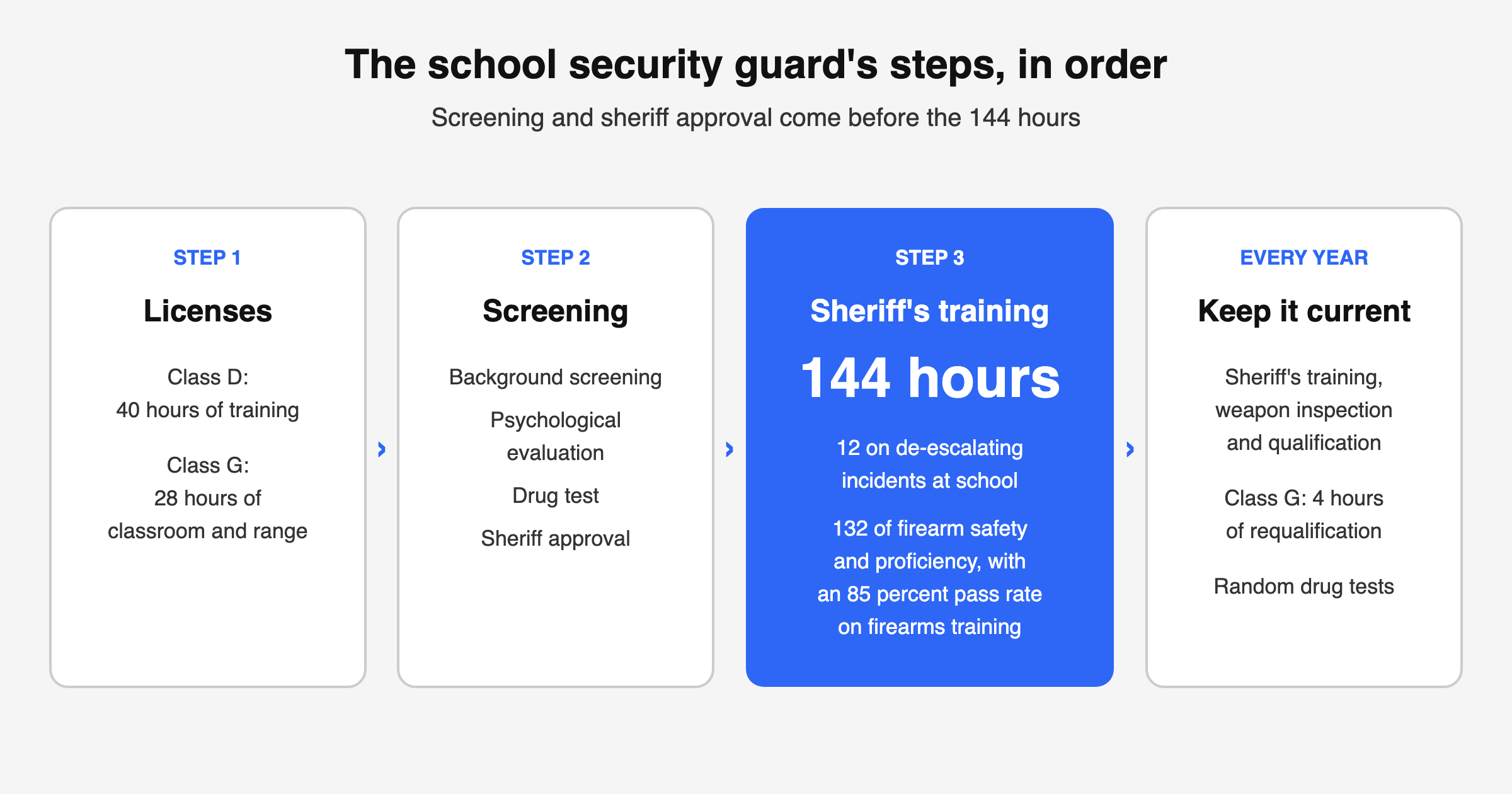
- Complete 144 hours of training conducted by a sheriff.
- Pass a psychological evaluation by a licensed psychologist designated by the Florida Department of Law Enforcement (FDLE).
- Pass an initial drug test and later random drug tests.
- Be approved by the sheriff of each county where they will be assigned. With that approval, the agency may assign the guard to any school in the county.
- Complete ongoing training, weapon inspection and firearm qualification with the sheriff at least once a year.
Background screening, the psychological evaluation, the drug test and sheriff approval must all be complete before the training begins. Only a sheriff may conduct the training.
The 144 hours are a standardized statewide curriculum: 12 hours on responding to and de-escalating incidents on school premises, and 132 hours of firearm safety and proficiency taught by Criminal Justice Standards and Training Commission (CJSTC) certified instructors. The 132 hours include 80 hours of firearms instruction based on the CJSTC Law Enforcement Academy model, with an 85 percent pass rate required, plus precision pistol, simulator exercises, active assailant scenarios, defensive tactics and legal issues.
Sheriffs may add training. The Pasco Sheriff's Office says it "sets a higher training requirement" and that its program totals 174 hours, including lunch breaks. FDLE publishes a calendar of upcoming trainings reported by sheriffs. As of November 2026, the Florida Department of Education's list of participating counties includes Hernando, Hillsborough, Manatee, Pasco, Pinellas, Polk and Sarasota.
Who pays
Under s. 30.15, the security agency that employs a school security guard pays all training and screening costs. Those charges may not exceed the sheriff's actual cost, and the sheriff may not waive them. For district and charter school guardians, the state funds the sheriffs' screening and training costs, and those employees receive a one-time $500 stipend.
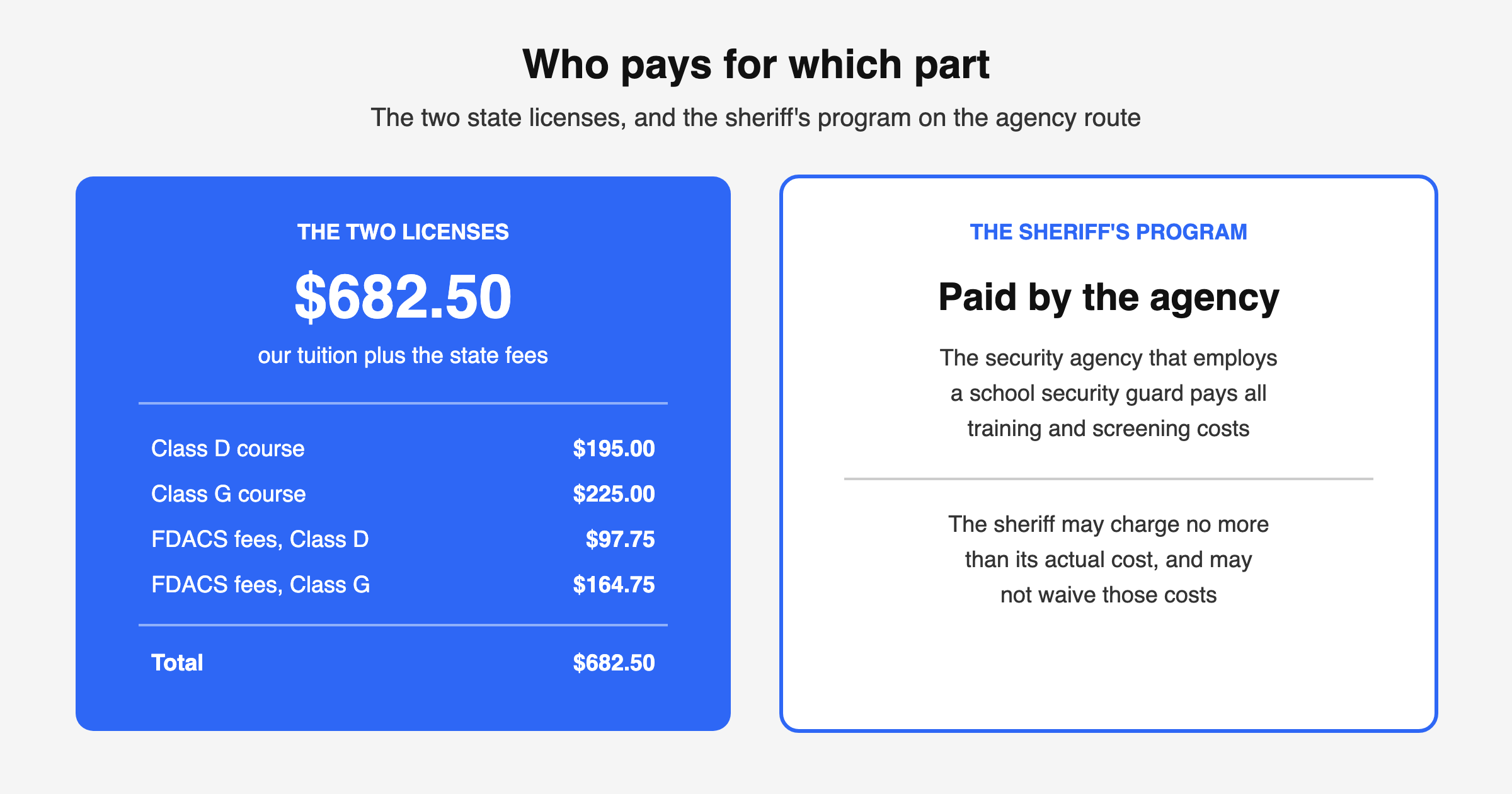
The two state licenses come before the sheriff's program. Our Class D course is $195 and our Class G course is $225. With the FDACS fees above, both licenses come to $682.50 in total.
What renews each year
- Class G requalification. In each year of the license period, a Class G licensee must complete at least 4 hours of firearms requalification taught by a Class K instructor. Our Class G Annual Requalification is $150 and includes a 48-round live-fire qualification.
- The sheriff's annual requirements. Ongoing training, weapon inspection and firearm qualification, at least once a year.
- Random drug tests, as the statute requires.
Once you complete the 144-hour program, you do not have to repeat it unless you have at least a one-year break in employment as a school security guard.
Where to start
Because a security agency can employ you as a school security guard only if you hold both licenses, the path starts with the Class D and Class G.
Our 42-hour Class D course teaches the state's 40-hour curriculum. You can take it in person in Tarpon Springs over four consecutive days or live online with an instructor. The Class G is 28 hours over three days in Tarpon Springs, taught by a licensed Class K firearms instructor. To apply for the Class G, you must have completed or be scheduled to complete the Class D program, or hold a valid Class D, C or CC license. As of November 2026, the next Class D runs January 25 to 28, 2027, and the Class G follows from January 29 to 31, so you can finish both in seven consecutive days. The next pair runs March 22 to 25 and March 26 to 28.
ESS Global, the agency that operates ESS Academy, is a licensed Florida security agency (license B 1200075) providing guard staffing and school security support across Tampa Bay.
To get started, register for our Class D course at https://essacademy.com/courses/d-unarmed-security-officer-license-course/, or for the Class G if you already hold a Class D. You can also call us at 727-293-5857.

You may also like

Training Fast and Training Hard!

Loaded Unarmed “D” Security Course!
